
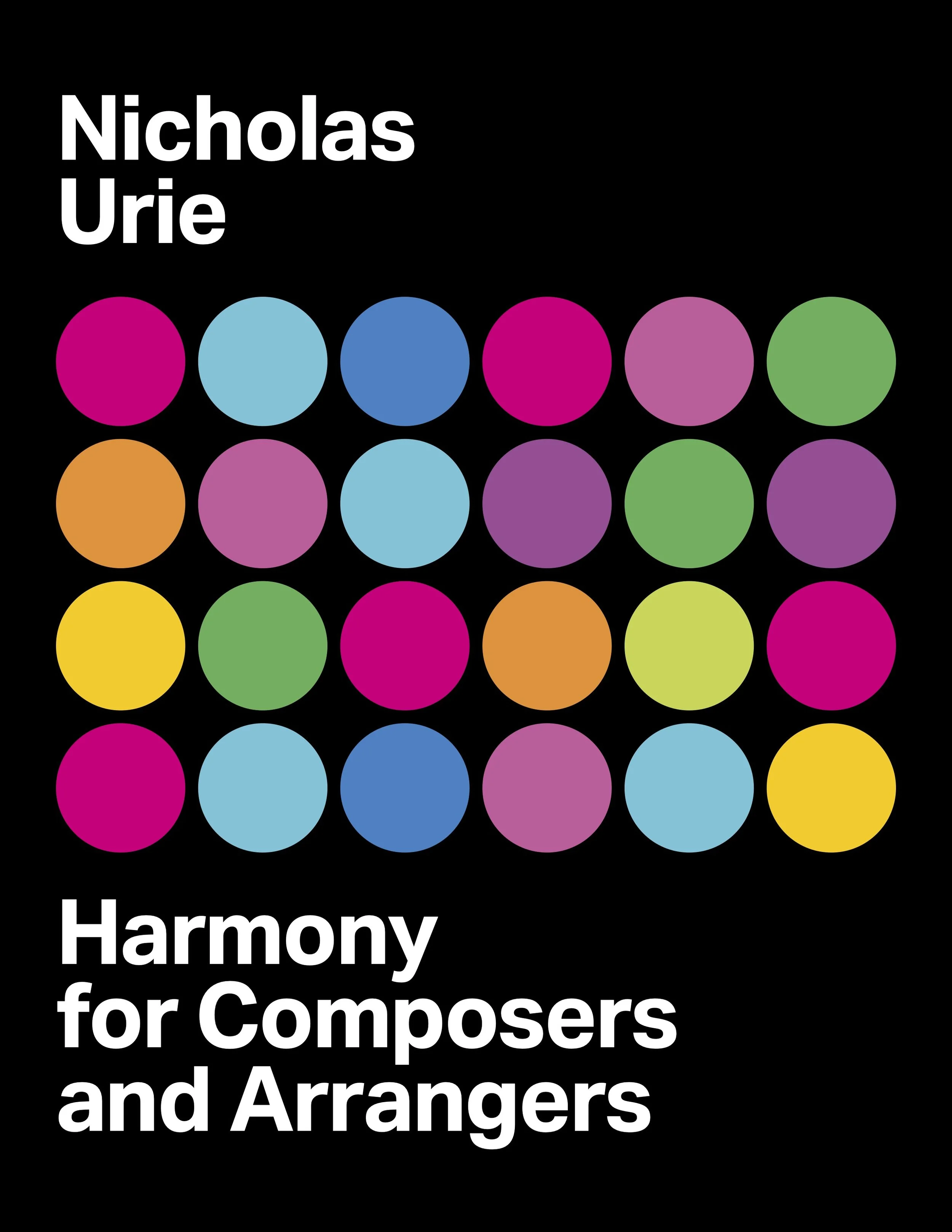
With simple, elegant tools, Harmony for Composers and Arrangers explores the harmonic grammar of twentieth- and twenty-first-century Western popular music and presents a streamlined overview of the harmonic issues arrangers and composers encounter when working in these music traditions. Author and seasoned educator Nicholas Urie unites the musical worlds of theory and arranging to illuminate the many options and techniques available to composers, arrangers, and students.
The book is organized as a glossary of conventional harmonic sounds that composers and arrangers encounter while working in Western popular music styles such as pop, jazz, folk, rock, and gospel. Building on the fundamental rules governing major key diatonic scale degree tendencies, Urie demonstrates how diatonic chords create a gravitational system as a result of the tensions inherent in the major scale--a system that forms the basis for contemporary Western popular music. Throughout the book, Urie addresses major and minor keys in tandem, covering chromaticism, the three most common types of modulation (direct, pivot, and sequential modulation), diatonic chords derived from Composite Minor, and secondary and substitute dominant chords. The book concludes with two full, original arrangements to demonstrate how the lessons learned can be put to practical use. Both arrangements show the original chord progressions of the songs along with an analysis of how they were altered in the arrangement process. Recordings of both arrangements are available on an accompanying website to enable readers to follow along with the scores.
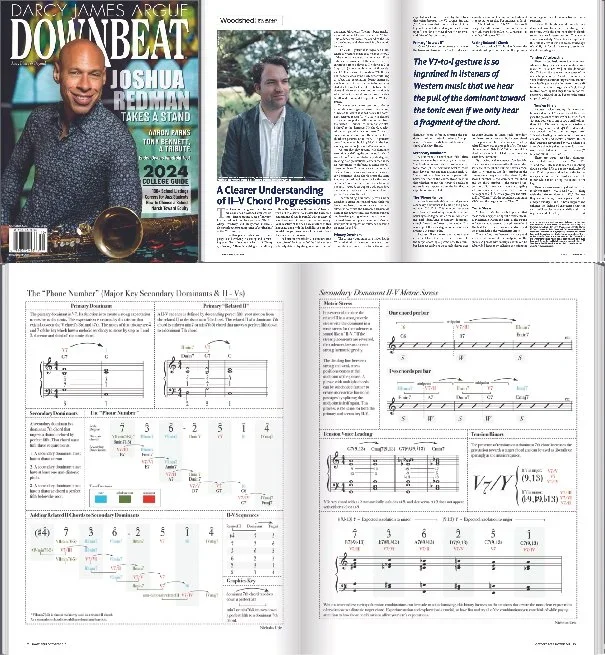
Downbeat: woodshed
October, Volume 90, Number 10
This article explores the mechanics of the most common cadential pattern in Jazz. This article breaks down the II-V cadence into easy to understand pieces and is written for beginning and intermediate music theory learners.
Something From Nothing
Foreword: Warren Schwartz - The Shape of Music
Nicholas Urie
The Harmonic Language of Rhythm Changes
Nicholas Urie
This document covers the basic Rhythm Changes framework and a number of strategies for reharmonizing the A section and bridge.
Part one covers reharmonizing the A section with secondary dominants, tritone substitutions, and the alternate tonic, including deceptive resolutions to the alternate tonic. Other common reharmonizations are also covered including the use modal interchange and diminished 7th chords.
Part two covers reharmonizing the bridge using related II’s and tritone substitutions.